The future of Shopping
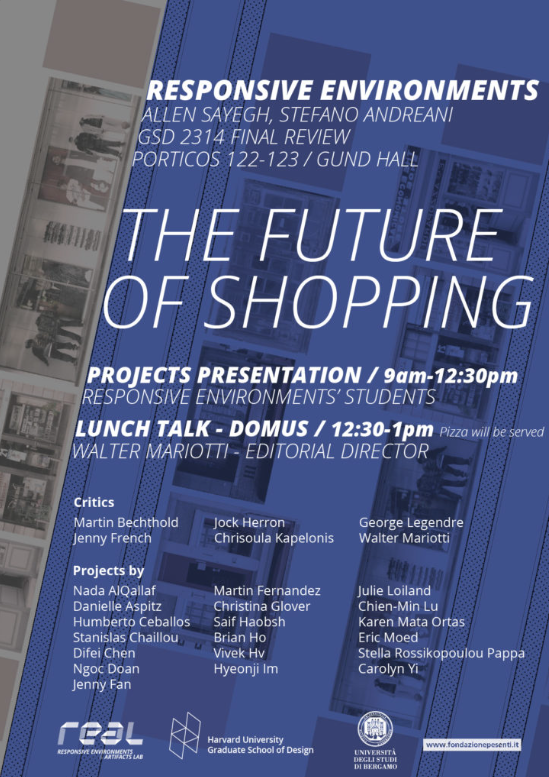
The Future of Shopping was the theme chosen for the course “Responsive Environments: Digital / Physical Retail 2017–18”, part of the Bergamo 2.035 | REAL Cities – Smarter Citizens program. This is a long-term, multidisciplinary research initiative promoted by the University of Bergamo and the Harvard Graduate School of Design, with the support of Fondazione Pesenti e the Municipality of Bergamo.
The research explores the challenges related to the integration of digital technologies and physical spaces within the retail world, examining both the opportunities and the consequences across urban, commercial, and domestic contexts, as well as user experiences in both tangible and virtual environments.
Through a comparative analysis of retail in the United States and Europe—supported by a systematic review of academic literature, case studies, and field investigations—the project aims to analyze the history of retail, understand current dynamics, and—focusing especially on the cities of Boston and Bergamo—propose innovative solutions at five different scales:
The shopping experience in retail stores
Shops and window displays
Smart home environments
Medium-sized shopping centers
Mobile and hybrid platforms
Main Topics
– DESIGN RESEARCH: An overview of the interaction between design and research. Design as a method to structure innovative research strategies, and research as a tool to generate new approaches to design. Examples and case studies from Harvard GSD complement the theoretical framework.
– DESIGN THINKING: A study of design thinking methodologies, applying novel and interdisciplinary approaches to address problems across various fields and scales. Often, solving a problem requires an innovative mindset that goes beyond conventional thinking. By combining subjective analysis with objective data, students are encouraged to reconsider business or design challenges from unconventional perspectives.
– HUMAN-CENTERED DESIGN AND USER EXPERIENCE: Principles of human-centered design, focusing on strategies to evaluate and anticipate the user experience from the perspective of diverse individuals. These strategies include: user experience scenarios, personal studies, user journey design, simulations, and modeling.
– RESPONSIVE TECHNOLOGIES: Opportunities and implications in integrating new media, sensors, and interactive technologies into cities, addressing the themes of technological longevity, dynamic adaptation, and augmented realities.
Responsive Evironments: the Future of Shopping

